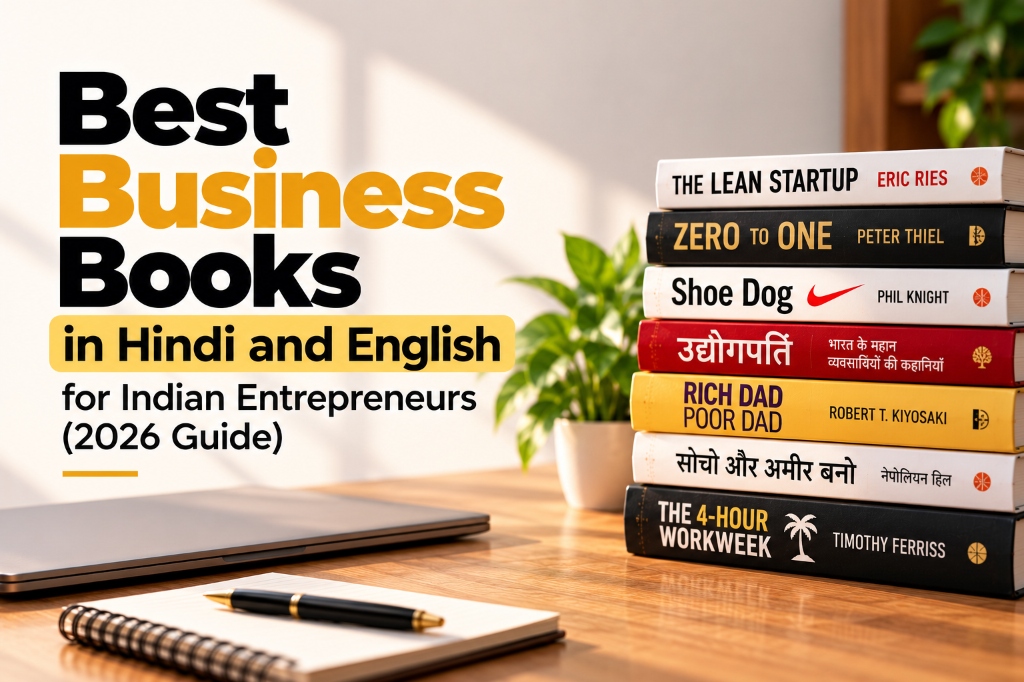
Imagine you have finally decided to start a side hustle, launch a startup, or scale the family business you already run. You open Google or YouTube, search for "best business books for entrepreneurs", and within minutes you are flooded with endless lists of 50+ books. Most were written specifically for Silicon Valley VC-funded software companies in the 1990s or 2000s, and virtually none tell you which single book to pick up first or how to apply those lessons inside the Indian business landscape.
In India, business is distinctly different. We operate in a fast-paced market driven by UPI micro-transactions, Tier-2/Tier-3 consumer psychology, working capital pressures, and intense local competition. High-flying American theories about burning investor cash to buy market share often lead Indian bootstrapped founders straight into bankruptcy.
This comprehensive 2026 guide changes that. Below, you will find the most impactful, field-tested business books available in both Hindi and English, categorized by your exact stage of business. You'll discover what each book actually teaches, how to adapt its framework for Indian conditions, and a realistic 90-Day Reading Roadmap so you stop collecting bookmarks and start generating real revenue.
💡 Key Takeaway: Reading 50 business books passively creates an illusion of competence. Reading just 3 foundational books and executing one concrete operational change per book will put you ahead of 95% of competing Indian entrepreneurs.
Quick Picks: The Founder's Executive Summary
If you have only two minutes right now, this quick-reference table tells you exactly where to begin based on your biggest current business bottleneck:
| Your Immediate Business Need | Recommended Book | Author | Language Editions | Difficulty |
|---|---|---|---|---|
| Understand Money & Cashflow Basics | Rich Dad Poor Dad | Robert Kiyosaki | Hindi & English | Beginner |
| Master Financial Psychology & Patience | The Psychology of Money | Morgan Housel | Hindi & English | Beginner |
| Build Daily Operational Discipline | Atomic Habits | James Clear | Hindi & English | Beginner |
| Deep Focus & High-Value Output | Deep Work | Cal Newport | English (Hindi avail.) | Intermediate |
| Test an Idea with Minimal Capital | The Lean Startup | Eric Ries | English | Intermediate |
| Escape Destructive Price Wars | Blue Ocean Strategy | W. Chan Kim & R. Mauborgne | English | Intermediate |
| Create Breakthrough Innovations | Zero to One | Peter Thiel & Blake Masters | English & Hindi | Advanced |
| Survive Startup Crises & Cash Crunch | Shoe Dog | Phil Knight (Nike) | English & Hindi | Beginner-Friendly |
| Automate & Build Remote Systems | The 4-Hour Workweek | Tim Ferriss | English & Hindi | Intermediate |
| Indian Strategy & Team Management | Corporate Chanakya | Radhakrishnan Pillai | Hindi & English | Beginner |
How We Curated This List (Our 4-Part Filter)
An honest guide must reveal its editorial criteria. We did not rank books by Amazon bestseller badges or celebrity influencer endorsements. Every single title on this shelf passed four rigorous tests:
- Actionable for Bootstrapped Founders: You should be able to implement the core framework within seven days, without an MBA degree, a corporate budget, or angel investment.
- Timeless Principles over Fads: Marketing tactics change every six months, but principles like margin of safety, unit economics, and customer retention have remained consistent for centuries.
- Plain, Conversational Language: Overly academic jargon causes founders to abandon books halfway through. A book left unread provides zero return on investment.
- Relevance to the Indian Market: We prioritized books that have outstanding Hindi translations or principles that directly apply to Indian supply chains, credit terms, and buyer behavior.
Part 1: The Foundation — Money Mindset & Execution Habits
Before launching marketing campaigns or designing pitch decks, you need a healthy, disciplined foundation: an unshakeable relationship with working capital and the daily habits required to execute relentlessly when motivation fades.
1. Rich Dad Poor Dad — Robert T. Kiyosaki Essential Mindset
The Core Thesis: You do not get wealthy by trading time for an hourly wage; you build sustainable wealth by acquiring income-producing assets (businesses, real estate, paper assets, intellectual property) that generate cash flow regardless of your active labor.
Why It Matters for Indian Entrepreneurs:
Traditional Indian culture often glorifies job security (Sarkari Naukri or MNC safety) while treating liabilities—such as expensive family cars or gold jewelry purchased on credit—as signs of success. Kiyosaki’s distinction between true assets (things that put money in your pocket) and liabilities (things that take money out) is an essential mental reset for anyone stepping out of traditional employment.
How to Apply in India: Never reinvest your business profits into vanity personal lifestyle upgrades during your first 3 years. Reinvest strictly into working capital inventory, marketing, and systems that lower customer acquisition costs. For a detailed chapter breakdown, explore our complete Rich Dad Poor Dad Summary in Hindi.
2. The Psychology of Money — Morgan Housel Cash Discipline
The Core Thesis: Financial success is not an engineering problem governed by equations; it is a soft skill governed by human behavior, ego control, patience, and surviving long enough to let compounding take effect.
Why It Matters for Indian Entrepreneurs:
Most Indian startups do not fail because their products are poor; they fail because founders run out of cash before achieving profitability. Housel teaches the psychological power of the "Room for Error" (Margin of Safety) and the freedom that comes with maintaining a healthy cash buffer.
How to Apply in India: Maintain at least 6 to 9 months of operational business runway in liquid fixed deposits or corporate liquid funds. When supplier payments are delayed (a routine occurrence in Indian commerce), your business will stay calm and operational while your competitors panic. Read our breakdown of the 7 Key Lessons from Psychology of Money in Hindi.
3. Atomic Habits — James Clear Operational Systems
The Core Thesis: You do not rise to the level of your goals; you fall to the level of your systems. Tiny 1% daily improvements compound into transformative business outcomes over 12 to 24 months.
Why It Matters for Indian Entrepreneurs:
Entrepreneurship is romanticized as visionary pitching and deal-making. In reality, 90% of running a profitable company is repetitive daily grind: answering customer support WhatsApps, auditing bookkeeping ledgers, following up on unpaid invoices, and optimizing ad creatives. Clear’s 4-step framework (Cue, Craving, Response, Reward) helps solo entrepreneurs establish non-negotiable daily work routines.
How to Apply in India: Create SOPs (Standard Operating Procedures) for routine tasks. Block 8:00 AM to 10:30 AM every morning exclusively for high-revenue business activities (sales outreach, product development) before opening social media or responding to messages. Dive into our Atomic Habits Summary in Hindi.
Part 2: Strategy, Validation & Startup Mechanics
Once your mindset and daily discipline are established, you need frameworks to validate your product ideas, minimize waste, and outmaneuver crowded competition.
4. The Lean Startup — Eric Ries Validation & MVP
The Core Thesis: Stop building elaborate products in isolation for 6 months hoping people will buy them. Build a Minimum Viable Product (MVP), launch immediately, measure real customer reactions, and iterate through the Build-Measure-Learn feedback loop.
Why It Matters for Indian Entrepreneurs:
Many first-time Indian founders burn ₹2 to ₹5 Lakhs on custom mobile app development, fancy logos, and office leases before confirming whether anyone is actually willing to pay for their service. Ries proves that customer validation must happen before capital expenditure.
How to Apply in India: Validate your product concept with a free Google Form, an Instagram page, or a simple landing page. If 10 strangers won't pay you an advance via UPI or commit their email address to join your waiting list, don't spend months building inventory.
5. Zero to One — Peter Thiel Monopoly Thinking
The Core Thesis: Doing what someone else already knows how to do takes the world from 1 to n (creating incremental copies). Doing something completely new takes the world from 0 to 1. Monopolies drive progress; cut-throat competition destroys profit margins.
Why It Matters for Indian Entrepreneurs:
In India, when one tea stall or digital agency succeeds, 20 identical clones open on the same street within 3 months, engaging in a suicidal race to the bottom on pricing. Thiel forces you to answer the hard question: "What valuable truth do you know that very few people agree with you on?"
How to Apply in India: Don't try to be "a cheaper version of an existing brand". Pick a hyperspecific, underserved niche (e.g., specialized bookkeeping software solely for Indian textile traders, or curated regional eBooks) where you can establish a localized monopoly.
6. Blue Ocean Strategy — W. Chan Kim & Renée Mauborgne Market Positioning
The Core Thesis: Cut-throat industry competition turns the ocean bloody red as rivals fight over the same pool of customers. Sustainable growth comes from creating "Blue Oceans"—uncontested market spaces that make the competition completely irrelevant.
Why It Matters for Indian Entrepreneurs:
Look at how Indian giants like Paper Boat reimagined traditional Indian drinks (Aam Panna, Jaljeera) instead of fighting Pepsi and Coca-Cola on carbonated cola sodas. Blue Ocean Strategy provides concrete analytic tools like the Strategy Canvas to eliminate unnecessary industry costs while elevating unique customer value.
7. Shoe Dog — Phil Knight (Memoir of the Creator of Nike) Founder Resilience
The Core Thesis: A raw, unvarnished look at the reality of building a global empire. For the first 18 years of Nike's existence, Knight was constantly on the verge of bankruptcy, wrestling with hostile banks, delayed shipments, and currency devaluations.
Why It Matters for Indian Entrepreneurs:
Most business books make success look tidy and algorithmic. Shoe Dog shows the messy, anxious truth of managing cash crunches, supply chain bottlenecks, and vendor betrayals. It is the ultimate antidote to imposter syndrome for any founder struggling to make payroll this month.
8. The 4-Hour Workweek — Timothy Ferriss Automation & Scale
The Core Thesis: Escape the 9-to-5 rat race by shifting from trading time for money to building automated systems, outsourcing low-leverage tasks, and leveraging the Pareto Principle (the 80/20 Rule) to maximize lifestyle freedom.
Why It Matters for Indian Entrepreneurs:
India has a massive pool of skilled freelance talent. As an entrepreneur, your job is not to handle every customer email, graphic design tweak, and invoice yourself. Ferriss teaches the DEAL framework (Definition, Elimination, Automation, Liberation) so your business works for you, rather than you becoming an unpaid employee of your own company.
Build Your Complete Entrepreneurial Library
Get instant, lifetime access to 12,000+ curated eBooks in Business, Startups, Personal Finance, Mindset, and Hindi classics. Read on mobile, tablet, or Kindle with zero subscription fees.
Get the Mega eBook Bundle (₹149 Lifetime)Part 3: Best Business Books in Hindi (हिन्दी में सर्वश्रेष्ठ व्यापारिक पुस्तकें)
Learning in your native language removes cognitive friction. When ideas are absorbed in the language you naturally think, negotiate, and sell in, implementation happens twice as fast. Here are the finest business and strategy books available in Hindi:
1. सोचो और अमीर बनो (Think and Grow Rich) — Napoleon Hill Hindi Classic
मुख्य विचार: यह पुस्तक दुनिया के 500 से अधिक सबसे सफल उद्योगपतियों (जैसे हेनरी फोर्ड, थॉमस एडिसन, एंड्रयू कार्नेगी) के जीवन और विचारों का 20 साल का अध्ययन है। यह सिखाती है कि सफलता केवल मेहनत से नहीं, बल्कि एक निश्चित लक्ष्य (Definite Purpose), अटूट विश्वास और मास्टरमाइंड टीम के सहयोग से प्राप्त होती है।
भारतीय व्यापारियों के लिए सीख: यदि आपके पास एक स्पष्ट व्यापारिक दृष्टि (Clear Vision) और अनुशासन है, तो सीमित संसाधनों के बावजूद भारत जैसे विकासशील देश में बड़ा व्यवसाय खड़ा किया जा सकता है। हमारे संग्रह में 15 सर्वश्रेष्ठ हिन्दी सेल्फ हेल्प बुक्स भी देखें।
2. उद्योगपति: भारत के महान व्यवसायियों की कहानियाँ Indian Case Studies
मुख्य विचार: धीरूभाई अंबानी, जे.आर.डी. टाटा, घनश्याम दास बिड़ला, और नारायण मूर्ति जैसे महान भारतीय उद्योगपतियों की संघर्ष और सफलता की वास्तविक गाथाएं।
भारतीय व्यापारियों के लिए सीख: विदेशी स्टार्टअप्स की तुलना में भारतीय उद्यमियों की कहानियाँ हमें लाइसेंस राज, सीमित पूंजी, पारिवारिक व्यापार और भारतीय ग्राहकों के विश्वास को जीतने के व्यावहारिक गुर सिखाती हैं। यह पुस्तक सिखाती है कि भारतीय बाज़ार में 'रिश्ते' और 'साख' (Trust & Reputation) सबसे बड़ी संपत्ति हैं।
3. चाणक्य नेतृत्व के रहस्य (Corporate Chanakya) — राधाकृष्णन पिल्लई Indian Strategy
मुख्य विचार: आचार्य चाणक्य के प्राचीन अर्थशास्त्र और नीतिशास्त्र के सूत्रों को आधुनिक कॉर्पोरेट मैनेजमेंट, टीम लीडरशिप और वित्तीय नियंत्रण पर लागू करना।
भारतीय व्यापारियों के लिए सीख: चाणक्य का 'सप्तांग सिद्धांत' (राजा, अमात्य, जनपद, दुर्ग, कोष, दंड, मित्र) हर छोटे-बड़े बिज़नेस पर सटीक बैठता है। यह पुस्तक टीम चयन, वित्तीय सुरक्षा (कोष) और प्रतिस्पर्धियों की रणनीति को समझने के लिए अनिवार्य है।
4. अग्नि की उड़ान (Wings of Fire) — डॉ. एपीजे अब्दुल कलाम Leadership & Resilience
मुख्य विचार: भारत के 'मिसाइल मैन' और पूर्व राष्ट्रपति डॉ. कलाम की आत्मकथा। यह पुस्तक सिखाती है कि शून्य से शुरुआत करके, भयंकर असफलताओं के बाद भी अपनी टीम का हौसला कैसे बढ़ाया जाता है और असंभव प्रोजेक्ट्स को कैसे पूरा किया जाता है।
भारतीय व्यापारियों के लिए सीख: जब आपके प्रोजेक्ट्स फेल हों, सप्लायर धोखा दें या बजट खत्म हो जाए, तो एक लीडर को जिम्मेदारी खुद लेकर टीम को आगे बढ़ाना चाहिए।
Part 4: Capital Allocation & Long-Term Wealth for Founders
A founder who builds a profitable enterprise but fails at personal capital allocation often ends up broke. These two masterpieces teach you how to protect and compound your retained earnings:
The Intelligent Investor — Benjamin Graham Value Investing
First published in 1949 and regarded by Warren Buffett as the greatest investment book ever written. Graham teaches the concept of "Mr. Market" (treating the emotional fluctuations of the market as an opportunity, not an instruction) and the non-negotiable principle of a Margin of Safety.
For Business Owners: Treat your own company's new product lines and equipment investments with the same discipline: never commit capital without a clear margin of safety protecting you against downside market shocks. For further reading, check our guide on the Best Personal Finance Books for Indians.
The Compound Effect — Darren Hardy Compounding Execution
Hardy demonstrates that small, seemingly insignificant daily choices—made consistently over hundreds of consecutive days—create staggering, exponential differences in business revenue, personal health, and wealth creation.
It pairs seamlessly with Atomic Habits, providing the psychological stamina required to stay focused during months where business progress feels flat and invisible. Explore our comprehensive 2026 guide to Personal Finance & Wealth Books in India.
The 90-Day Step-by-Step Reading Roadmap
Reading without a structured sequence leads to cognitive overload. Do not jump straight into complex corporate valuation manuals when your cash flow habits are disorganized. Follow this battle-tested 90-day sequence:
| Phase & Timeline | Core Focus | Books to Complete | Mandatory Action Checkpoint |
|---|---|---|---|
| Days 1 – 30 The Foundation |
Cashflow Mindset & Behavioral Control |
1. Rich Dad Poor Dad 2. The Psychology of Money |
Separate your personal bank account from your business bank account. Audit every single recurring expense and build a 3-month cash buffer. |
| Days 31 – 60 Execution & Focus |
Daily Systems & Deep Productivity |
1. Atomic Habits 2. Deep Work |
Block 2.5 hours every single morning without phone or email notifications. Use this window exclusively for direct revenue-generating activities. |
| Days 61 – 90 Strategy & Scale |
Validation, Positioning & Customer Fit |
1. The Lean Startup 2. Zero to One or Blue Ocean Strategy |
Launch an MVP test offer to 5 genuine prospective buyers. Collect real feedback before committing capital to inventory or software. |
The "One Book, One Action" Implementation SOP
The single biggest difference between amateur dreamers who collect hundreds of books and successful founders who build lasting enterprises is active application. Implement this 3-rule Standard Operating Procedure:
- Rule 1: One Book, One Concrete Action. Within 7 days of finishing any business book, identify exactly ONE specific process, policy, or marketing experiment inspired by the book and implement it immediately. Write it on a sticky note on your laptop screen.
- Rule 2: Synthesize Notes in Your Own Words. Don't just highlight sentences on your Kindle or dog-ear pages. Write a 5-bullet summary in your personal notebook answering: "How does this apply to my current customers this month?"
- Rule 3: Implement Before Purchasing the Next Title. Place a self-imposed lock on your reading queue: you are forbidden from opening a new business book until your action from the previous book is live in the real world.
If you are deciding between screen-based reading or paper copies for your daily study blocks, read our objective analysis on Digital Reading vs Physical Books for Learning & Retention.
Where to Acquire These Business Books Affordably
Investing in your education should never compromise your working capital. Here are the smartest ways to access these titles in India:
- Local City & College Lending Libraries: Most major Indian cities (Delhi, Mumbai, Bengaluru, Pune, Hyderabad, Kolkata) have historic lending libraries (like the British Council Library or Asiatic Society) offering physical and digital access for nominal annual fees.
- Second-Hand Book Markets: Famous hubs like Daryaganj (Delhi), College Street (Kolkata), Flora Fountain (Mumbai), and Avenue Road (Bengaluru) offer mint-condition used paperbacks at 60–80% discounts.
- Curated Lifetime eBook Libraries: Buying 20 individual business books on Kindle or paper can easily cost ₹8,000 to ₹12,000. If you prefer reading on your smartphone, tablet, or laptop, curated bundles like our own Skill Library Mega eBook Bundle provide lifetime Google Drive access to 12,000+ curated books across business, investing, personal growth, and Hindi literature for a single one-time payment of ₹149. (Check our transparent refund policy and eBook bundle buyer guide for full details).
4 Lethal Reading Traps Every Founder Must Avoid
- Trap 1: The Multi-Book Paralysis. Starting four books simultaneously ensures you finish none. Commit to one primary business guide and read it cover to cover before branching out.
- Trap 2: Chasing the Shiny New Release. Books published in the last 6 months have not stood the test of time. A book that has been actively recommended for 15+ years (like The Lean Startup or The Intelligent Investor) contains far denser, more durable wisdom.
- Trap 3: Mistaking Motivation for a Strategy. Watching motivational speeches or reading hype-heavy books gives you an emotional dopamine rush that lasts 12 hours. Real business progress requires an Excel spreadsheet, a customer phone call, and a measurable invoice.
- Trap 4: Blindly Copying Silicon Valley Models. American advice regarding venture-debt subsidies, zero-interest-rate unit economics, and aggressive ad burn does not translate cleanly to the Indian context. Always adapt frameworks to Indian GST, payment gateways, and local buyer psychology.
Frequently Asked Questions (FAQs)
Which business book should a complete beginner in India read first?
Start with Rich Dad Poor Dad (available in both English and Hindi). It requires zero prior financial or commerce background and delivers the single most critical mental distinction in capitalism: understanding what actually constitutes an asset versus a liability.
Are Hindi business books as effective as English business books?
Absolutely. In fact, for entrepreneurs whose native language is Hindi, reading in Hindi prevents cognitive fatigue and helps you internalize concepts faster. Renowned titles like Chanakya Neeti, Wings of Fire (अग्नि की उड़ान), and Hindi translations of global classics are outstanding resources.
How much time should a busy entrepreneur dedicate to reading daily?
Just 20 to 30 minutes every morning is enough to finish 15 to 20 pages per day. At that modest pace, you will comfortably finish 18 to 24 transformative business books every single year.
Is reading eBooks effective for serious business study?
Yes. Digital eBooks allow you to highlight crucial frameworks, search keywords instantly, and carry thousands of reference guides on your phone wherever you go. Many founders highlight quotes in eBooks and sync them directly to Notion or digital notebooks for ongoing reference.
Can reading business books guarantee that my startup will succeed?
No book can guarantee entrepreneurial success. Business involves uncontrollable market variables, timing, and competitive dynamics. What books provide is an unfair advantage: they help you avoid expensive mistakes that other founders already spent millions of dollars discovering the hard way.
Final Thoughts: Transform Knowledge into Revenue
The most valuable business book in the world is not the one with the most prestigious award—it is the one you actually finish and put to work in your daily enterprise. Start with your financial mindset, solidify your daily execution habits, and test your business models against real paying customers.
Within 90 days of following this disciplined approach, you will operate with clearer strategic thinking, tighter financial control, and genuine market momentum. That is worth infinitely more than hundreds of unread bookmarks on your browser.