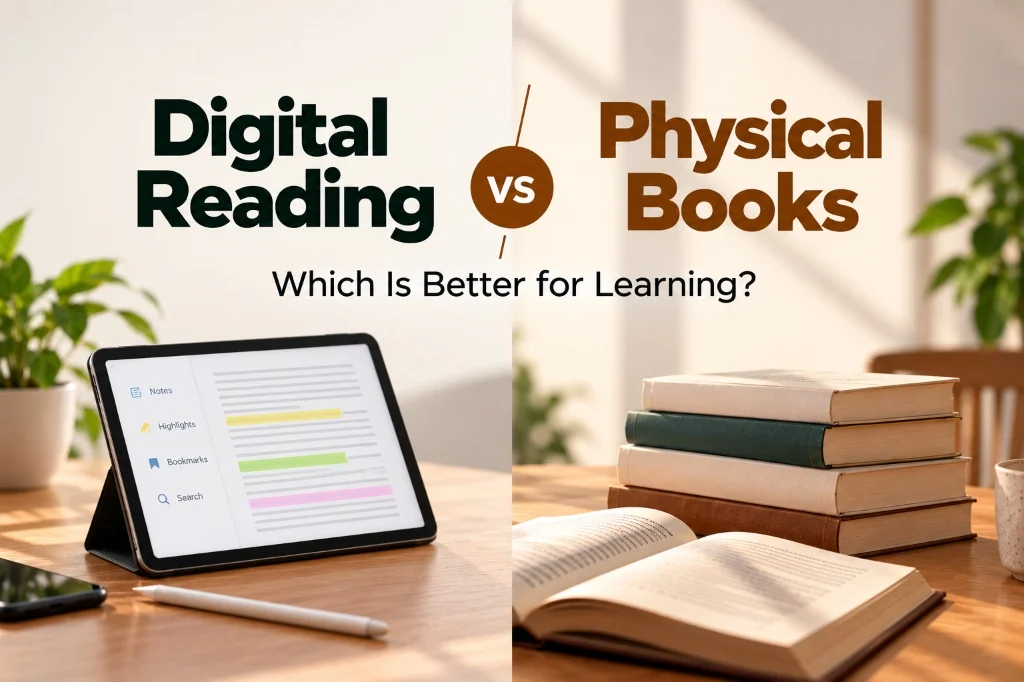
Few debates in the learning and personal development world spark as much passionate controversy as this one: digital reading versus physical books.
For book purists, nothing matches the tactile feeling of turning crisp paper pages, the distinct aroma of fresh ink, and the nostalgic pride of filling a physical wooden bookshelf. But for modern thinkers, entrepreneurs, college students, and lifelong learners navigating our fast-paced information age, carrying a portable library of 10,000+ digital books in their pocket is an unparalleled superpower.
However, when the objective is learning, memory retention, deep focus, and real-world application, which medium actually wins?
Does reading on a screen harm your comprehension? Can digital notes help you remember concepts faster? And in India's rapidly growing self-education ecosystem, how can you combine the cognitive benefits of both mediums without spending tens of thousands of rupees on paperbacks?
In this comprehensive 2026 guide, we break down peer-reviewed cognitive research, brain mapping, retention experiments, cost analyses, and a battle-tested Hybrid Reading Framework to help you optimize your daily learning workflow.
1. The Cognitive Science: How Your Brain Reads Paper vs Screens
To determine which medium is superior for learning, we must understand how the human brain processes textual information. Human beings were never biologically born to read; reading is an invented cultural technology that requires the brain to co-opt visual and linguistic circuits (a process cognitive scientist Dr. Maryanne Wolf calls neuroplastic re-wiring).
A. The "Cognitive Map" and Spatial Memory of Physical Books
When you hold a physical book, your brain naturally creates a physical and sensory map of the text:
- Spatial Landmarks: You remember that a breakthrough concept appeared on the top-left corner of a page, about two-thirds through the thickness of the book.
- Kinesthetic Feedback: As you progress, the weight of pages shifts from your right hand to your left hand. This physical feedback reinforces your mental timeline of the author's arguments.
- Zero Screen Glare: Paper reflects ambient light rather than emitting artificial photons directly into your eyes, keeping cognitive fatigue low during marathon reading sessions.
In an influential study conducted by Professor Anne Mangen at Norway’s University of Stavanger, two groups of participants read the exact same 28-page mystery story—one group on a paperback and the other on an Amazon Kindle. When tested on plot chronology and structural recall, readers of the physical book scored significantly higher in reconstructing the sequence of events.
B. The "Screen Inferiority Principle" — Myth or Reality?
In educational psychology, researchers often refer to the Screen Inferiority Effect. Early studies from the 2010s demonstrated that readers tended to skim digital screens using an "F-shaped" scanning pattern, searching for keywords rather than engaging in contemplative "deep reading."
However, neuroscientists discovered that this behavior was not caused by the digital medium itself, but by device association and learned habits:
- Most people read screens on smartphones where notifications, social media apps, WhatsApp messages, and multitasking constantly fracture attention.
- When readers switch to dedicated E-ink screens (such as Kindle, Boox, or Kobo) or put their tablets into airplane mode, comprehension scores for non-fiction match paper books almost 1:1.
- The ability to instantly look up difficult vocabulary, highlight passages, and search concepts creates a powerful interactive feedback loop that passive paper reading cannot match.
2. Head-to-Head Comparison: Comprehension, Speed & Retention
Let's look at the direct, objective comparison across all key learning parameters:
| Learning Parameter | Physical Print Books | Digital eBooks (PDF / EPUB) | Winner for Learning |
|---|---|---|---|
| Deep Chronological Narrative | Sensory anchors and tactile weight help map story timelines seamlessly. | Progress bar helps, but spatial memory is less vivid for plots. | Physical Books |
| Searchability & Speed | Manual page-flipping; index lookup takes several minutes. | Instant `Ctrl+F` search across thousands of pages in seconds. | Digital eBooks |
| Active Highlighting & Export | Permanent ink on pages; notes remain locked inside the physical book. | Export digital highlights directly to Notion, Obsidian, or flashcards. | Digital eBooks |
| Focus & Distraction Vulnerability | 100% offline, zero popups, zero notifications, pure flow state. | Vulnerable to notification interruptions if reading on phones/tabs. | Physical Books |
| Storage & Portability | Heavy, bulky; carrying 5 books on a trip is inconvenient. | Carry 12,000+ books on a single phone or lightweight reader. | Digital eBooks |
| Reading in the Dark / Commuting | Requires external reading lamp; difficult to handle in crowded trains. | Built-in warm backlighting; read comfortably in beds or buses. | Digital eBooks |
| Cost & Affordability (India) | ₹400–₹800 per book; building a 50-book library costs ₹25,000+. | Massive curated bundles available for under ₹200 one-time. | Digital eBooks |
| Eye Comfort & Circadian Rhythm | Zero blue light; ideal for relaxing reading before bedtime. | Requires warm light mode or E-ink to avoid sleep cycle disruption. | Physical Books |
3. The Economic & Practical Factor in India (2026 Reality)
While theoretical debates about paper versus pixels are fascinating, we cannot ignore the economic reality of books in India today.
In 2026, the retail price of popular self-help, finance, and productivity paperbacks has skyrocketed. A single paperback edition of bestselling titles like Atomic Habits, The Psychology of Money, or Rich Dad Poor Dad retails between ₹350 and ₹650 on Indian e-commerce platforms.
If an ambitious student or young professional aspires to read just two books every month for personal growth, that translates to an annual expenditure of ₹10,000 to ₹15,000 on paperbacks alone!
Furthermore, consider physical space constraints:
- College students living in hostels or shared PGs do not have the shelf space to store 50 heavy books.
- Young professionals who relocate between Bangalore, Delhi, Pune, or Mumbai find packing and moving boxes of heavy paperbacks cumbersome and expensive.
- Paper books are susceptible to moisture, page yellowing, termite damage, and accidental spills.
This is why comprehensive digital collections like our Best eBook Bundle in India have become a nationwide sensation. For a single one-time payment of just ₹149, readers get permanent, lifetime Google Drive access to 12,000+ curated eBooks across personal finance, business, psychology, fitness, and Hindi literature.
That is less than the cost of a single cup of premium coffee for a lifetime digital library!
4. What Type of Books Work Best in Each Format?
Not all books require the same cognitive approach. The secret to mastering learning is knowing which format matches which subject:
Finance books require regular searching of metrics, asset formulas, and tax strategies. As detailed in our guide to Best Personal Finance Books & eBooks India 2026, digital finance books allow you to quickly cross-check principles like compounding and budgeting on your phone.
Timeless classics like Morgan Housel's masterpiece benefit from deep contemplation. Check out our detailed breakdown of The Psychology of Money summary in Hindi to understand how behavior trumps mathematical intelligence.
Action-oriented guides like James Clear's work are meant to be revisited daily. Review our complete Atomic Habits Hindi summary for actionable frameworks you can implement straight from your smartphone.
Foundational business manuals like Robert Kiyosaki's philosophy on cash flow and assets are best kept in a searchable digital repository. Read our guide on Rich Dad Poor Dad Asset vs Liability for practical breakdowns.
Finding pristine physical copies of famous Hindi motivational titles can be tough in tier-2 and tier-3 cities. Explore our curated list of the 15 Best Self Help Books in Hindi, all available in clean, high-resolution digital format.
If you are solving differential equations, writing complex chemical mechanisms, or flipping back and forth between appendix formulas, large-format physical books still hold a distinct cognitive advantage.
5. The 4-Step "Hybrid Reading Strategy" Used by Top Learners
Rather than choosing an "either-or" dogmatic stance, high-performing executives, entrepreneurs, and researchers in 2026 practice a Hybrid Reading Model. Here is the exact 4-step framework:
-
Read 80% Wide and Digital:
Use a digital ebook library to explore broadly. Browse 10 different books on marketing, psychology, or money management. Sample chapters freely without financial guilt. If a book doesn't resonate within the first 30 pages, abandon it and move to the next. -
Turn On "Do Not Disturb" Mode:
When reading digitally on a phone or tablet, eliminate notification friction. Turn off notifications, switch your screen color temperature to warm/amber, and activate full-screen reading mode. -
Build a "Digital Second Brain":
Whenever you discover a life-changing quote, framework, or statistic, highlight it. Unlike physical books where notes gather dust on a shelf, copy or export your digital highlights directly into note-taking tools like Notion, Apple Notes, or Google Keep. Organise them by topic (e.g., `#Investing`, `#Mindset`, `#Productivity`). -
Buy Physical Copies Only for Your "Top 5 Holy Grail" Books:
Reserve physical book purchases strictly for the 5% of transformative books that you intend to re-read every single year for decades. Display them proudly on your desk as environmental anchors of your personal philosophy.
6. How to Eliminate Screen Fatigue When Reading eBooks
If you find that reading digitally causes eye strain or headaches, small environmental adjustments make a massive difference:
- Switch to E-Ink or Paper-Like Readers: E-ink screens (like Kindle Paperwhite or Onyx Boox) utilize micro-capsules of real black and white pigment. There is zero backlight shining into your pupils, making reading as gentle on your eyes as traditional paper.
- Use the 20-20-20 Rule: Every 20 minutes of reading, look at an object at least 20 feet away for 20 seconds. This relaxes the ciliary muscles in your eyes and prevents digital ocular fatigue.
- Choose the Right Font & Margins: Reading in sans-serif fonts on high-density displays can strain the eyes over long periods. Switch your reading app to serif typography such as Georgia, Baskerville, or Bookerly, and increase line spacing to 1.5x.
- Never Read in Pure Darkness on LCD: If reading on an iPad or smartphone at night, keep a warm ambient side lamp turned on. High-contrast screens in pitch-black rooms cause rapid pupillary dilation and eye strain.
Frequently Asked Questions
For chronological stories, fiction, and dense technical textbooks, physical books provide a 6% to 10% cognitive retention advantage due to tactile landmarks. However, for non-fiction, self-help, business, and skill-building books, retention between digital and print is virtually equal when readers actively highlight, take notes, and read without notifications.
A hybrid approach is recommended. Use physical notebooks and textbooks for complex mathematical derivations and active handwriting practice. Use digital eBooks for rapid search, reviewing concept summaries, accessing thousands of reference books, and carrying materials during commutes.
Yes, vastly cheaper. A single bestselling English paperback in India costs ₹400–₹700. Buying 20 books costs ₹10,000+. By contrast, Skill Library provides a lifetime Google Drive library of 12,000+ curated eBooks covering Finance, Mindset, Habits, and Hindi Self-Help for a one-time payment of just ₹149.
EPUB is reflowable—meaning the text resizes smoothly whether you read on a 6-inch phone or a 10-inch tablet. PDF preserves the exact layout, page geometry, charts, and diagrams as printed, making it ideal for finance reports, business models, and visual guides.
Standard LCD screens emit blue spectrum light that suppresses melatonin production. To avoid this, switch to dark mode with warm amber filter after 9 PM, or read on a dedicated E-ink display which emits no direct blue light.
Absolutely. Results come from action, not the paper binding. When you highlight key habits from digital books, review summaries regularly, and integrate them into your daily routine, you learn faster and can access inspiration anywhere at any time.
Ready to Build Your Own Ultimate Digital Library?
Gain instant lifetime access to 12,000+ curated eBooks across Personal Finance, Mindset, Business, Habits, Fitness, and Hindi Self-Help.
Lifetime Google Drive Access — Only ₹149 (One-Time)
Get Instant Access — ₹149- 12,000+ handpicked premium eBooks across 9 shelves
- Instant Google Drive link sent directly to your email
- Read effortlessly on Mobile, Tablet, Laptop, or Kindle
- Zero subscription fees — pay once, keep forever